The home where Carter G. Woodson lived, worked and launched what became Black History Month reopens to the public Saturday in Shaw after a full renovation.
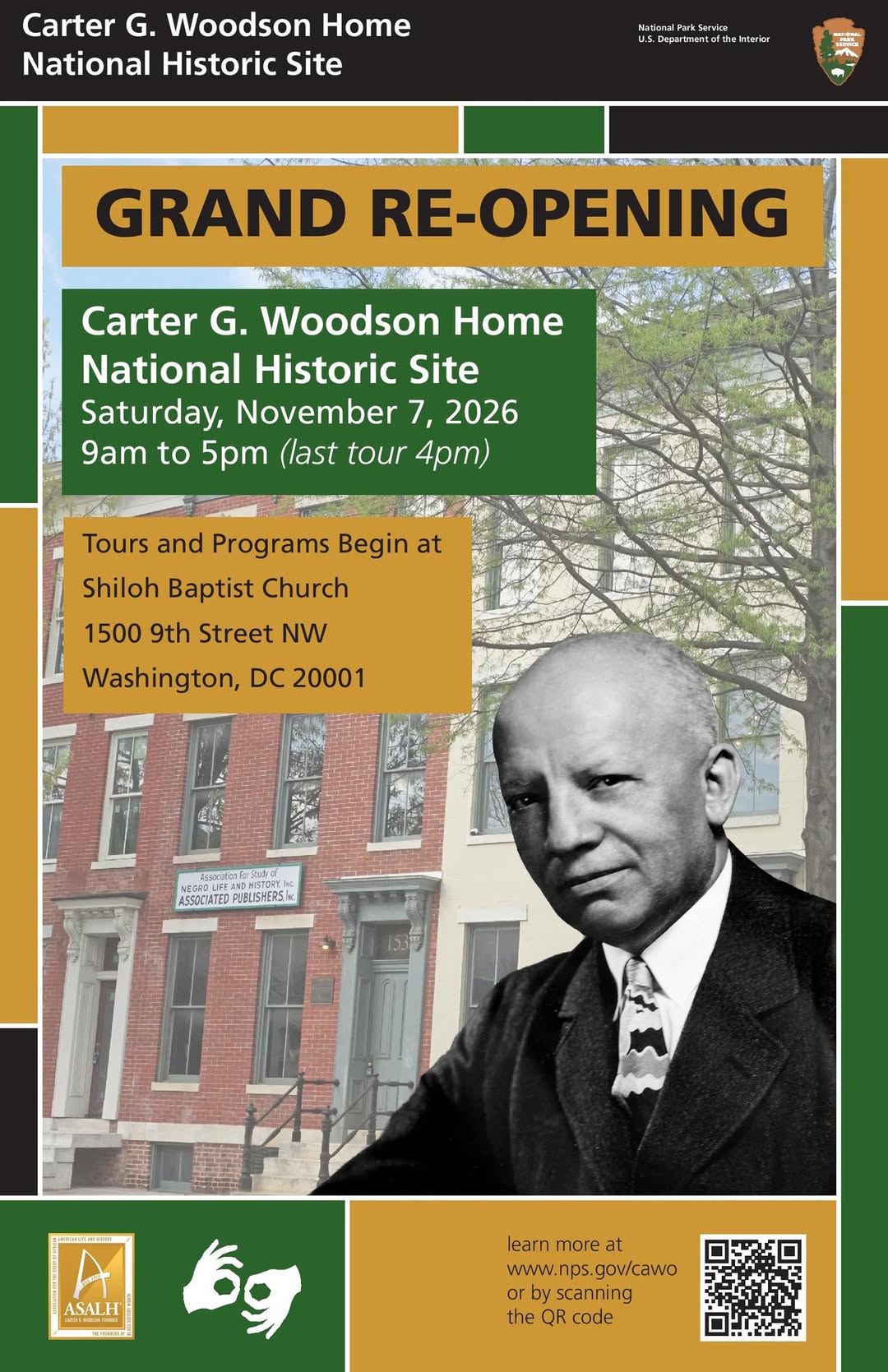
The Carter G. Woodson Home National Historic Site at 1538 9th St. NW will hold a free grand reopening event on Saturday, Nov. 7, as Sarah Payne reported for MidCity DC News. The National Park Service (NPS) and the Association for the Study of African American Life and History (ASALH) are co-hosting the event, according to the site's official Facebook page.
The reopening gives the public access to Woodson's restored home and a new visitor center with exhibits.
What to expect Saturday
The event runs 9 a.m. to 5 p.m. Free tour tickets will be handed out on a first-come, first-served basis from 9 a.m. to 4 p.m. No advance registration is required.
All tours and programming begin at the historic Shiloh Baptist Church, 1500 Ninth St. NW. Visitors pick up tickets at a National Park Service welcome tent at the church. Multiple tours will run each hour, guiding guests through the new visitor center and into Woodson's home.
The day's lineup includes guided house tours, walking tours through the Shaw neighborhood, hands-on children's programs and music. A "Meet Dr. Carter G. Woodson" program is also on the schedule.
Regular hours start Nov. 10
After the grand reopening, the site will open to the public Tuesday through Saturday, 9 a.m. to 5 p.m., beginning Nov. 10. Visit nps.gov/cawo for details.
Who was Carter G. Woodson?
Woodson, widely known as "the Father of Black History," was born on Dec. 19, 1875, in New Canton, Virginia. He was the fourth of nine children born to parents who had been enslaved, according to the National Park Service biography.
He earned a PhD in history in 1912. Three years later, on Sept. 9, 1915, he co-founded what is now ASALH. His home at 1538 9th St. NW served as the organization's headquarters. Woodson established Negro History Week there in 1926. That observance grew into what Americans celebrate as Black History Month.
The building was designated a National Historic Landmark in 1976.